
Most businesses do not suffer from a lack of marketing activity. They have advertising campaigns running, articles being published, landing pages being redesigned, and new tools constantly being added to the stack. From the outside, the marketing department appears busy. Inside the business, however, growth can still feel unpredictable.
The problem is often that the company has accumulated marketing channels without building a marketing system. Paid media generates leads that sales considers irrelevant. SEO brings traffic to pages that have no clear role in the customer journey. Content attracts readers but gives them nowhere useful to go. CRM data sits in one platform, advertising data in another, and revenue figures reach the marketing team several weeks too late.
Each activity may look successful on its own. Together, they may produce little commercial momentum.
Full-stack marketing addresses this fragmentation by connecting strategy, positioning, acquisition, conversion, customer communication, and analytics around a shared business goal.
What full-stack marketing actually means
Full-stack marketing is sometimes described as the ability of one marketer to manage strategy, advertising, SEO, content, design, CRM, and analytics. This may sound efficient, but it is rarely realistic. These are different disciplines that require different skills.
A more useful definition focuses on the system rather than the individual.
Full-stack marketing is an integrated approach in which the main marketing functions are planned, executed, and measured as connected parts of the same growth process. Depending on the company, the stack may include:
- Market research and positioning
- Brand strategy and messaging
- Website and landing page development
- Paid advertising
- SEO and content marketing
- Email and CRM
- Marketing automation
- Conversion optimization
- Analytics and attribution
A business does not need to activate every item on this list. A young B2B company may begin with a clear offer, a focused landing page, paid search, basic content, and CRM tracking. An established e-commerce brand may need paid social, SEO, lifecycle email, retention mechanics, and product analytics.
The exact combination changes. The principle does not: every element should have a defined role and support the same customer journey.
Why separate marketing channels underperform
Dividing work among specialists is not the problem. Most companies need people with different areas of expertise. Fragmentation begins when nobody is responsible for the connections between their work.
Imagine a company that hires one agency to manage advertising, another to handle SEO, and a freelance team to redesign the website. Each contractor receives a separate brief and KPI. The advertising team reduces cost per lead, the SEO team increases traffic, and the designers deliver a modern-looking website. Everyone completes their assignment, but the business still fails to generate more qualified opportunities.
The reason is that channel-level performance is not the same as business growth. A low CPL means little if those leads never become customers. More organic traffic is not particularly valuable if it comes from people who will never need the product. A beautiful website will not convert if visitors cannot quickly understand what the company offers.
A connected approach starts with commercial questions:
- Which customers create the most value?
- What prevents the company from growing today?
- Why do customers choose this product over alternatives?
- Where do potential buyers hesitate or leave?
- What happens after someone submits a form?
- Which marketing activities contribute to actual sales?
These answers should determine the marketing stack. Sometimes the priority is paid acquisition. In other cases, the company first needs clearer positioning, a better landing page, faster sales follow-up, or cleaner CRM data.
Full-stack marketing is not about doing more. It is about solving the most important problems in the correct order.
Build one customer journey, not six channel plans
Customers do not experience a company as a collection of departments. Someone may discover a brand through a social post, encounter it again in an advertisement, search for reviews, read an article, leave the website, and return two weeks later to request a consultation.
Internally, these interactions may belong to several teams and reports. For the customer, they form one relationship with one brand.
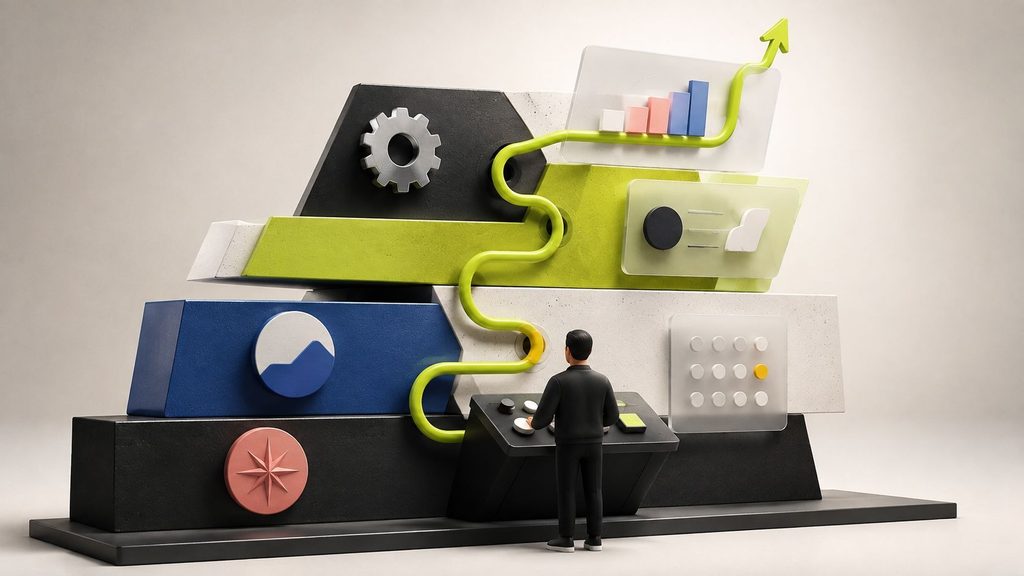
This is why consistency matters. If an advertisement presents the product as simple and accessible but the website immediately becomes technical and confusing, the journey breaks. If an article gives honest advice but the next email sounds like an aggressive sales script, the journey breaks again.
In a full-stack system, every channel has a specific role. For example:
- Paid social introduces the problem and creates initial awareness.
- Search advertising captures people already looking for a solution.
- SEO content answers questions during the research stage.
- Product pages and case studies provide evidence.
- Retargeting and email bring interested visitors back.
- CRM workflows help sales prioritize and follow up.
- Analytics shows which activities produce qualified opportunities and revenue.
The channels should not repeat exactly the same message. A person discovering the category needs different information from someone comparing vendors. However, each interaction should reflect the same positioning, value proposition, and understanding of the customer.
Connect acquisition, conversion, and CRM
One of the most common marketing mistakes is investing heavily in traffic while treating the destination as a secondary concern. Companies refine targeting, test dozens of advertisements, and adjust bids every week, but continue sending every visitor to the same generic homepage.
An advertising campaign creates a specific expectation. The landing page has to continue that conversation.
Someone searching for a particular service should reach a page that explains that service. A cold social media audience may need more context before being asked to schedule a call. A returning visitor may be ready for a case study, comparison, or consultation.
This is why advertising, content, UX, copywriting, and web development should not operate as unrelated production lines. The campaign determines who arrives and what they expect. The page determines whether that expectation is met. The follow-up process determines whether initial interest becomes a commercial conversation.
Marketing also cannot end when a lead form is submitted. A submitted form may come from a future customer, an irrelevant vendor, a student doing research, or someone outside the target market. Even a valid lead can disappear if nobody responds quickly.
The CRM should help the team answer several questions:
- Was the lead valid and relevant?
- Did the sales team make contact?
- Was the prospect qualified?
- Did a meeting take place?
- Was an opportunity created?
- Did the opportunity become revenue?
- Which campaign influenced the result?
Without this information, marketing naturally optimizes for the cheapest visible conversion. A campaign producing 100 low-quality leads may look better than one generating 20 expensive leads that result in five new customers.
CRM data changes the conversation from “Where did we get the most leads?” to “Where did we get the customers the business actually needs?”
Measure decisions, not activity
Marketing dashboards often contain every metric a platform can export. They may look comprehensive while failing to explain whether the business is growing.
Impressions, clicks, rankings, and engagement remain useful. They help diagnose the performance of individual channels. But they need to be connected to commercial indicators such as:
- Landing page conversion rate
- Cost per qualified lead
- Lead-to-meeting rate
- Sales-qualified opportunity rate
- Customer acquisition cost
- Pipeline and revenue by channel
- Retention or repeat purchase rate
The purpose of reporting is not to prove that marketing has been busy. It is to show what the company should improve next.
If qualified traffic is rising while conversions remain flat, the landing experience may need attention. If lead volume is growing but opportunities are not, the problem may involve targeting, qualification, or sales follow-up. If the company generates strong opportunities but acquisition costs are too high, it may need to reconsider channel economics, pricing, or the sales cycle.
No single metric tells the whole story. The value comes from understanding how the metrics relate to one another.
Build the system in layers
Trying to rebuild the brand, website, advertising, CRM, content, and analytics simultaneously usually creates more chaos. A practical full-stack system should be developed in stages:
- Create the foundation. Define the audience, positioning, offer, commercial goals, and unit economics.
- Prepare the infrastructure. Set up the website, landing pages, CRM, analytics, and lead-handling process.
- Launch acquisition. Choose the channels most likely to reach the right customers now.
- Develop organic assets. Build SEO, content, email, partnerships, or community around the same strategy.
- Optimize and automate. Use real customer data to improve campaigns and automate processes that already work.
The system does not have to be large. For some businesses, it may consist of one focused offer, several strong landing pages, two acquisition channels, useful content, a CRM, and reporting from the first visit to the final sale.
Its strength comes from the connections, not the number of tools.
When an external full-stack team makes sense
Creating an integrated marketing system requires expertise in strategy, advertising, SEO, design, development, content, CRM, and analytics. Expecting one in-house marketer to perform all these functions at a high level usually produces an overloaded generalist rather than an effective department.
A large company may have enough work and internal resources to build every function in-house. For a startup, a growing business, or a company entering a new market, assembling the complete team can be slow and expensive.
An external team can provide these capabilities more flexibly, but only if it takes responsibility for how they work together. Hiring several unrelated contractors may reproduce the same fragmentation under a different structure.
The value of a full-stack digital marketing partner lies not simply in having access to more specialists. It comes from connecting research, strategy, creative production, acquisition, conversion, CRM, and analytics around the same commercial objectives.
A good partner should be able to explain why each channel is being used, how it supports the customer journey, what data will be collected, and how that information will influence future decisions. If the proposed strategy is simply a long list of services, it is not yet a system.
Full-stack marketing is not about being everywhere
An integrated approach does not require a company to appear on every platform, publish something every day, or build the most complicated technology stack available. Being everywhere is often just an efficient way to dilute both budget and attention.
The better question is whether the company is present where its customers make decisions and whether every interaction leads somewhere useful.
Sustainable growth rarely comes from discovering one magical platform. It comes from understanding how customers move from awareness to purchase and making sure that marketing supports this process at every important stage.
A connected system does not eliminate uncertainty. Campaigns will still fail, audiences will change, and some ideas that looked excellent in a presentation will perform terribly in the real world. The difference is that every experiment produces information the entire company can use.
That is the real purpose of full-stack marketing: not to do more marketing, but to make every part of it contribute to the same direction of growth.